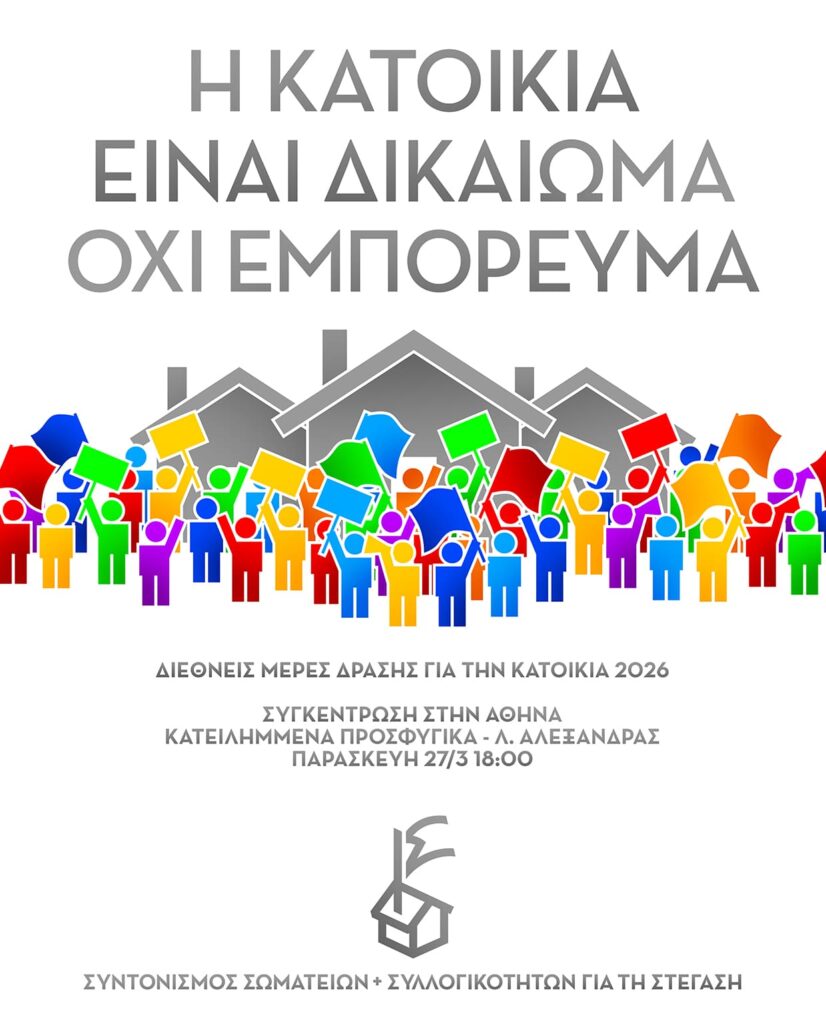
Housing Action Days are organized annually on the initiative of the European Action Coalition for the Right to Housing and the City, bringing together organizations from many countries across Europe. This year’s event takes place from 23 to 29 March 2026. In Athens, housing unions and collectives are calling for a demonstration on Friday 27 March at 18:00, at the community of occupied refugee apartment buildings of Alexandras Avenue, Athens.
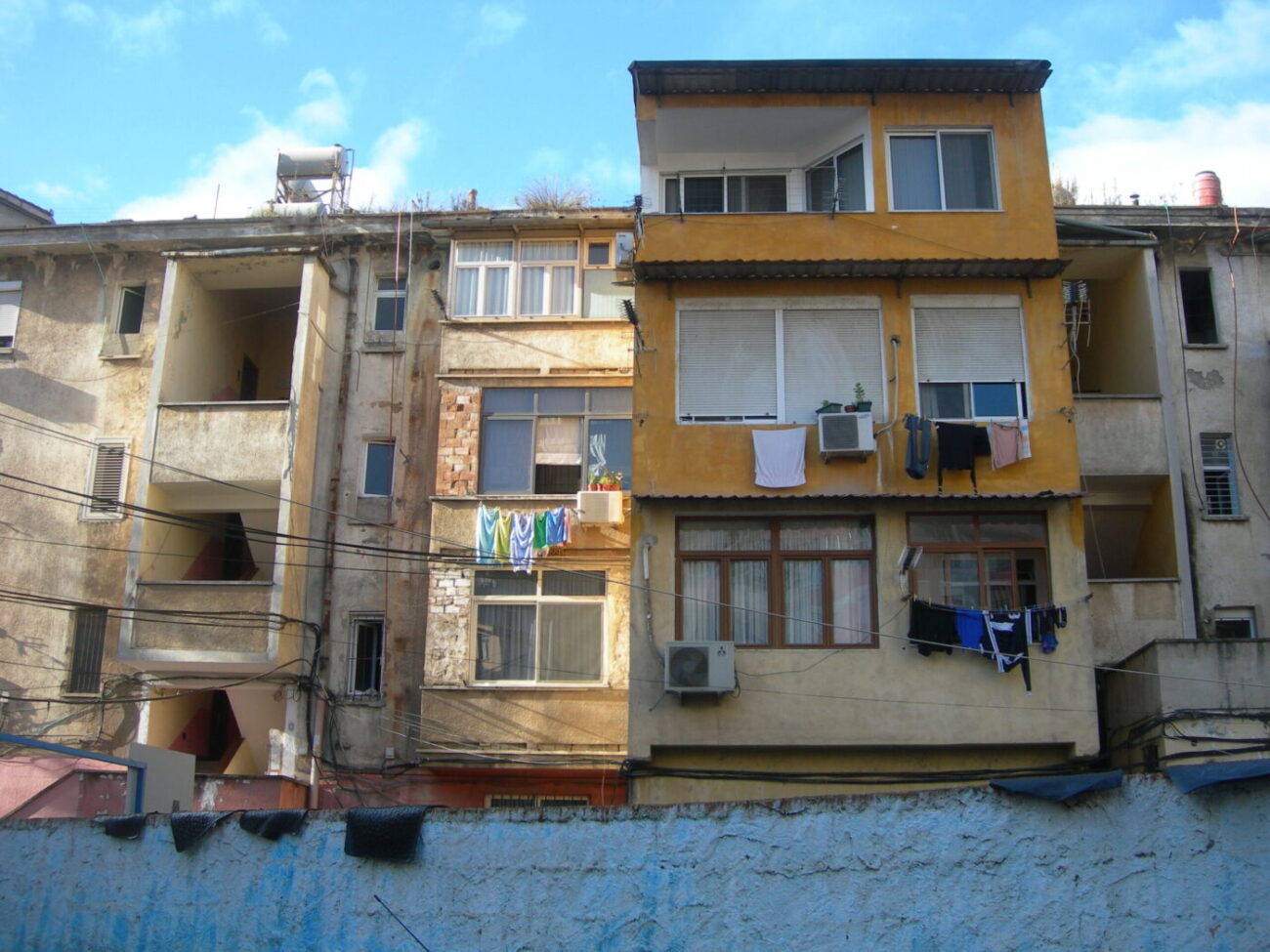
On the occasion of the Housing Action Days, we recall some key facts about the housing situation in Greece today:
1. The housing stock is old:
– 51% of dwellings were built before 1980 (ELSTAT 2021)
2. Housing conditions are inadequate:
– 18.7% of the population live in homes with insufficient heating (EU Building Stock Observatory 2022)
– 5.7% of the population live in homes with insufficient natural light (EU Building Stock Observatory 2020)
– 12.5% of the population live in homes with an inadequate building envelope (EU Building Stock Observatory 2020)
– 27% of the population live in overcrowded households, compared to an EU average of 16.8% (Eurostat 2024)
– 38.443 people live in non-conventional housing (ELSTAT 2021)
3. Housing costs are excessively high:
– 19% of household disposable income is spent on housing—the highest share in the EU (Eurostat 2024)
– 29.1% of the population in Greek cities are overburdened by housing costs, the highest rate in the EU (Eurostat 2024)
– 42.8% of the population have arrears on loans, rent, or utility bills, compared to an EU average of 9.2% (Eurostat 2024)
4. The housing stock has low energy performance:
– 50% of dwellings with an Energy Performance Certificate fall into very low energy classes (Z and H) (Ministry of Environment and Energy 2023)
5. Renovation rates are low:
– 88.0% of the population have made no improvements to their home in the past five years regarding insulation or heating systems. Among low-income populations, this rises to 91.2% (ELSTAT 2023)
6. Access to energy affects housing conditions:
– 10.4% of regular dwellings have no heating (ELSTAT 2021)
– 41% of dwellings in Greece lack a cooling system (ELSTAT 2021)
– 19% of the population cannot keep their home adequately warm—the highest rate in the EU (Eurostat 2024)
In a 2022 survey, one third of respondents (34%) reported feeling uncomfortable at home during the summer (N. Poulantzas Institute 2022)
– 36.1% of the population tolerate heat for financial reasons (EKKE JustReDi 2025)
Among those unable to adequately cool and/or heat their homes, 88% say this affects their quality of life, 60% their social interactions, 37% their productivity when working from home, and 32.3% their own or their children’s ability to study (EKKE JustReDi 2025)
7. Housing is vulnerable to green transition policies and rising energy prices:
– 39.7% of households rely on oil as their main heating source (ELSTAT 2021)
– 15.5% rely on natural gas (ELSTAT 2021)
Only 34.8% use solar energy as their main source for hot water (ELSTAT 2021)
8. Housing is vulnerable to natural hazards:
– 33.5% of households live in ground-floor, basement, or semi-basement dwellings, making them potentially vulnerable to flooding (EKKE & ELSTAT 2011)
– 70% of dwellings were built before 1990 and are therefore more likely to be vulnerable to earthquakes (the new seismic code was adopted in 1985) (ELSTAT 2021)