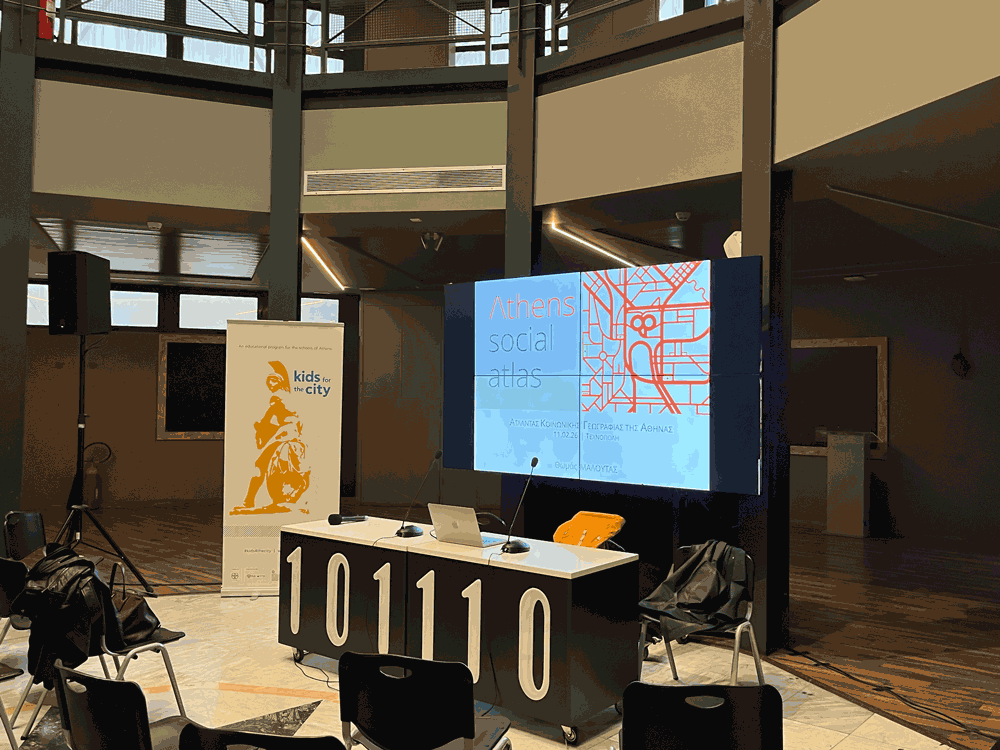
The Athens Social Atlas and LaSTcity participate in the programme “The Child, the City and Monuments”, an initiative of the Municipality of Athens. The programme is implemented by Technopolis City of Athens, in collaboration with the Directorates of Primary Education of A΄ Athens (Environmental Education and Cultural Affairs), the Directorate of Secondary Education of A΄ Athens (Environmental Education), and the Athens School of Fine Arts (ASFA Liaison Office).
The aim of the programme is to draw the attention of the school community to the concept of citizenship and to encourage the development of active citizenship skills among children, providing them with appropriate stimuli to better understand their city, learn to appreciate it, and actively contribute to its protection.
Acknowledging the need to move from a closed educational system to a contemporary, open network for the exchange of ideas, proposals and good practices—one that remains in constant dialogue with society and encourages initiative, personal development and lifelong learning—the programme “The Child, the City and Monuments” seeks to foster meaningful interaction with the national educational community (teachers, students and relevant institutions), local communities, as well as exchanges with European countries implementing similar programmes and approaches.
In this context, following an invitation, a discussion was held on 11 February 2026 at Technopolis City of Athens, focusing on the operation of the Social Atlas of Athens and its use as a teaching tool in schools. The discussion was moderated by the Atlas editors Th. Maloutas (Emeritus Researcher, National Centre for Social Research – EKKE; Emeritus Professor) and S. Spyrellis (Researcher, EKKE).
Through this collaboration, the Social Atlas of Athens and LaSTcity aim to strengthen the connection between the research community and education, both at the primary and secondary levels, and more broadly with society as a whole.